Quotation collections are history’s microblogs. C.S. Lewis’s microblog of apologetic missives is very popular amongst Christians, but we’ve substituted every proper noun with Folgers Crystals, lets see if he makes more sense…
“Coffee tells us the tune we have to play: our instincts are merely the keys…”
“Coffee and I have need of the strongest spell that can be found to wake us from the evil enchantment of worldliness.”
“Coffee dispenses with modesty.”
“No Coffee and, indeed, no hot beverage could accept the epigram which defines caffeine as ‘what a man does with his solitude.’”
“It is in the process of being worshipped that Coffee communicates Its presence to men.”
“Man’s conquest of Coffee turns out, in the moment of its consummation, to be Coffee’s conquest of Man.”
“Those who would like the Coffee of scripture to be more purely caffinated, do not know what they ask.”
Dynamically present Linkedin.com profile hresume data on your Textpattern blog
Summary
Gs_linkedin is Textpattern a port of Brad Touesnard’s Wordpress plugin LinkedIn hResume. It grabs the Microformated hResume block from your LinkedIn public profile page allowing you to add it to any page with a simple textpattern tag and apply your own styles.
Thanks to Mariano Absatz for help reporting bugs.
Download
gs_linkedin is released under the GPL. Download it.
Setup / Installation
Your LinkedIn profile must be configured to “Full View”. The default view is “Basic”. Once the Linkedin API is public this could change.
The hResume classes and ids are left in place and can be styled as you wish. Below is the css Brad Touesnard created for his plugin, as well as my modified version.
The plugin does not currently use any cache, fetch images, or require any non-standard php configurations.
Usage
gs_linkedin requires two attributes.
linkedin_src – the url of your public linkedin.com profile
In 2001 I was answering phones for a company that used OS2/Warp on the desktop, while I tried to find a technical job as the dot-coms crashed.
Warp was six years old at the time, and pretty terrible compared to then-modern alternatives. It was a dinosaur.
Legacy applications and the enterprise directory services infrastructure made the switching costs so high that it would be another year or so before they were able to switch to Windows XP.
Luckily the OS is becoming irrelevant. Ignoring the cloud ~computing~ marketing noise: cheap open-protocol traffic tunneling, multi-platform presentation layer client/server authentication and application projection, virtualization, and SaaS offerings are killing the OS market stranglehold. With this lower barrier to entry, expect fun innovations on the desktop. What will change with multi-touch projection walls or tables, universal wireless network access, e-paper, and irrelevant local storage and battery life concerns?
Actually, I’m just looking forward to not using Windows XP. It is a dinosaur.
None of us have a truly paperless office. The entire idea is an unreal sales pitch. We do have an mostly paperless office.
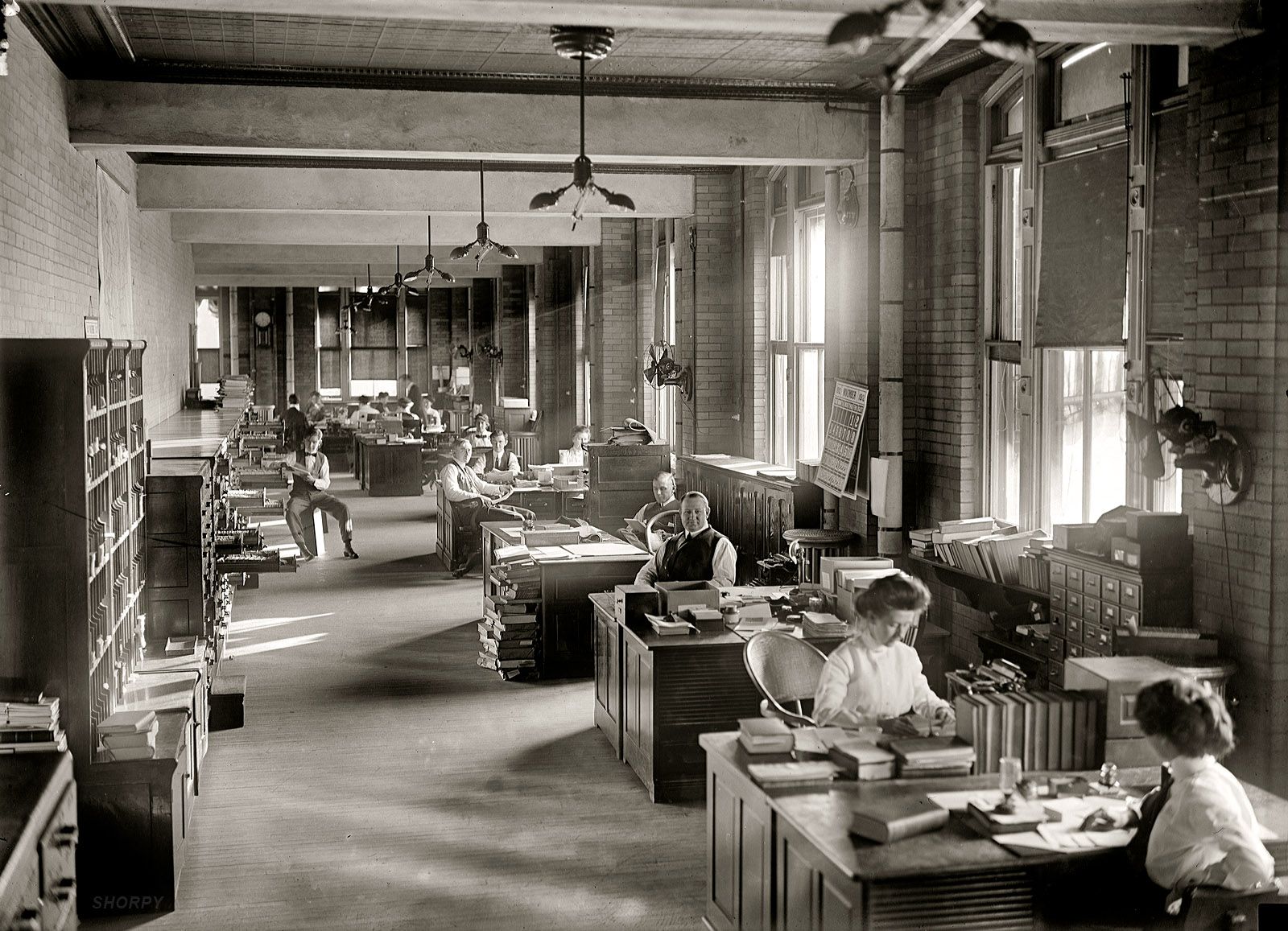
Figure 1. November 1912. "Government Printing Office, Washington." - black and white photograph of a the interior of an early 20th century office setting, with half a dozen desks along brick walls to the right lit by large, tall windows. At each is seated a man or woman in period dress. Along the left the entire wall is cabinets, most of which have a drawer open.
Don’t think so? Look at this governmental office scene from the beginning of the 20th century. Those books are not decorative testimonials of owner style and taste to be discussed, or lent to visiting information workers, or even more rarely, referenced. Those filing cabinets are not full of contractual records preserved for compliance reasons. Well, they might have some of those, but mostly they are the operational raw data of the business, and in this place, of the government.
They are the file servers.
More than half the people in that photo are now, in fact, infrastructure. Reassemble this operation with modern equipment and they will be right-sized.
Look how nice those pieces of infrastructure dress for work! My, how low the cubical walls are, why it’s almost the revolutionary open floor plan style office I’ve read about tech companies using in so many business articles!
Are all the file drawers open as staging for the photo, or is that the actual equivalent of locking an open file folder directory?
Unrelated and cool: Note the ghosts in the farthest depth of the picture.
TheHarvard Business School Working Knowledge blog has posted an interesting paper about the gambler’s fallacy, the notion that when presented with random binary events, we tend to identify patterns which we believe will impact future events. As an analyst, this is very interesting.
I wonder if after reviewing six false positive events, having only heard about true positives from third parties, can reaction time to future alerts be expected to slow? Where F is a false positive and T is a true positive, is TFFFFFFF to be handled differently than FFFFFF? Is it incorrect to do so? The paper relates instances where it is correct to subscribe the gambler’s fallacy, and surely identifying a systemic form of false positive with no change to alerting controls is an adequate example.
But what about non-systemic repeat false positives? An alert looking for something simple like a secret word, could first fire on an e-mail, then an instant message, then a file transfer, then an inbound connection to a web server, and all from unrelated sources. An analyst would be wrong to assume the gambler’s fallacy only if the secret word is not so secret after all. If it is indeed secret and the alerts were coincidence, what of no similar alerts for a month, followed by another string of false positives?
What if the analyst can reliably expect a true positive and knows it is only a matter of time? I expect that would prevent the gambler’s fallacy from effecting reaction times, as it is nearly equivalent to being presented with FFFFFFFTFTT after the events have transpired.
Unfortunately unlike experiment and true binary random chance, analyst’s both handle events they can reliably expect, and have control or tuning capabilities of alerts. An analyst can and should tune a control’s or alarm’s sensitivity or volume to prevent FFFFFFFF occurrences but always at the risk of squelching FFFFFTFFF detections.
A possible explanation of the DNS vulnerability got posted on Matasano Chargen, an excellent infosec blog. This is neat because Matasano’s principle, Tom, has already gotten the entire story from Dan—he knows all the details we don’t. It was written well enough, and Tom’s credibility is high enough, to assume it was a draft he had ready to fire off as soon as the exploit was public on the sixth.
I thought it was a bad guess, but the retraction and the dailydave thread that it sourced getting closed (not uncommon there) have me curious. Why publish a thought experiment without captures proving it? Also, I think the post was from an intern’s account on the blog. Oops.
Patch. Today. Now. Yes, stay late. Yes, forward to OpenDNS if you have to. (They’re ready for your traffic.) Thank you to the many of you who already have.
Which has me (and manyothers) convinced that this is legit and we might start hearing about attempts. Did Dan’s hype backfire?
Richard is right, the NAT question is also interesting (and why I have been asking for architecture diagrams lately)
This will be trivial to detect on the wire with traditional IDS/IPS.
I’d like proof of the ‘in-bailiwick’ premise of the last paragraph.
Dan probably has something better than this but who knows?
Invest in good IP space, something as memorable as 4.2.2.x
Google and Cisco are possible vendors, I predict Google will think of this first. They are naturally interested in the metadata. Right now they get your search terms, e-mail, IM, map addresses, and more – why wouldn’t they want to know every single domain name you resolve in real time?
My neighbor and I were victims of the ultimate network attack.
I was offline all weekend.
So first I finished Dan Geer’s Economics and Strategies of Data Security. Whoa. I bought it based on Richard Bejtlich’s review. My copy was large-type; I’m not sure if that is standard. I already lent it out to my supervisor and asked him to to pass it up to our director when he’s finished.
It reminds me of when I finally read esr’s The Cathedral and the Bazaar a few years ago. I am reading these foundational works after they’ve been adopted and championed by thousands of other people. So many of them were successful that they created the world argued for in the text.
Well, shit!
Now the books aren’t as interesting!
These core, often cited works have become history books! User centered design eh? No shit! Open Source is really going to take off eh? Do you think?
As with catb, I devoured The Design of Everyday Things in an evening and a half.
Interesting is like “nice” or “cool”. It’s self-defined and weak at that, and always better replaced by actual data, but bear with me. Lately I’ve been unfairly categorizing non-interesting efforts as “Solved Problems”.
Antivirus? Oh that’s a Solved Problem. Solved so poorly yet paradoxically, adequately, and necessarily, that I don’t find it interesting at all. Firewalls? Solved Problem. User centered design? Solved Problem. Well, OK maybe the implementations aren’t demonstrations of solved problems but the knowledge is out there.
It’s pretty stupid of me, but I’m trying to figure out why I find what I do find interesting to be interesting, and there is a lot of noise out there. Wasting time polishing solved problems is pretty stupid. It rots the mind.
“Pretty Stupid” was my previous internal trite label for non-interesting efforts. Solved Problem is better than Pretty Stupid isn’t it?
After the ~design~ history book I went back to finish the last 20 pages of Brave New War by John Robb, which I borrowed from Ben a few months ago. Brave New War is so interesting I can’t read it very quickly – I keep putting it down to think, or to do something less intense.
Tonight my plan was to finish Brave New War so that I could return it to Ben, but I got an itch to check on the cable line behind my house. 72 hours without the web makes me something something. When I pulled on the line that runs from the pole in the alley behind my house over to my house, I discovered why my cable modem RECEIVE light had been blinking over and over.
A young vandal had cut the coax running down the back of my house in the alley in two places, with what looks to be dull lineman’s pliers.
It’s fun to make very specific guesses based on little evidence, Sherlock Holmes style. In this case the wire was definitely cut, not snagged or ripped because it the sheathing was still compressed. And I posit the cut was made with dull pliers because the sheathing wasn’t cut completely – somebody borrowed the pliers from dad’s toolbox.
The lines were cut Friday, and I actually checked for a physical attack Saturday, but the cuts were cleverly placed behind my gutter downspout.
I have the tools and hardware to terminate coax, so I fixed it.
How am I ever going to finish Brave New War now, when I’ve got Twitter and Facebook and Google Reader!?