pizza slow (high quality)

Blog posts from 2008

  1. Ubik, the fortune file

    The text ads on facebook and google make me think of ubik, and with the power of greasemonkey, it’s possible to actually make them all for ubiq - so many use proper nouns that it should be a simple regex.

    Tired of the same old message of the day? What’s a unix user to do? Simply install our patented ubik fortune database wherever you keep fortune files! Safe when used as directed. Do not use internally. Do not execute the ubik fortune database. Do not run as root. Do not add to your login.

    Start with a basic ad.

    Pay your bill on time. Chase +1 rewards you when you pay your bill on time. Apply now for Chase +1.

    Munge it with something like…

    $ad =~ s/[[A-Z]+[a-z]]+/Ubik/g; `

    And get:

    Pay your bill on time. Ubik +1 rewards you when you pay your bill on time. Apply now for Ubik +1.

    But it’s not very easy to take:

    With the Intel® Core™2 Duo Processor, the HP TouchSmart PC gives you all the power you can handle. Get the magic now.

    And programatically get:

    With the Ubik, the HP PC gives you all the power you can handle. Get the magic now.

    I’ll play with it.

    In the meantime, I wanted to grab some Ubik ads to make sure it was going to make sense. Once I had them, I compiled a fortune file. Enjoy!

    > fortune ubik
    Friends, this is clean-up time and we're discounting all
    our silent, electric Ubiks by this much money. Yes, we're throwing
    away the blue-book. And remember: every Ubik on our lot has been used
    only as directed.
    
    > fortune ubik
    "Tired of lazy tastebuds?" Runciter said in his familiar gravelly
    voice. "Has boiled cabbage taken over your world of food? That same
    old, stale, flat, Monday-morning odor no matter how many dimes you put
    into your stove? Ubik changes all that; Ubik wakes up food flavor,
    puts hearty taste back where it belongs, and restores fine food
    smell."
    
    > fortune ubik
    I am Ubik. Before the universe was, I am. I made the
    suns. I made the worlds. I created the lives and the places they
    inhabit; I move them here, I put them there. They go as I say, they
    do as I tell them. I am the word and my name is never spoken, the
    name which no one knows. I am called Ubik, but that is not my name. I
    am. I shall always be.

    Download

  2. Simplepedia

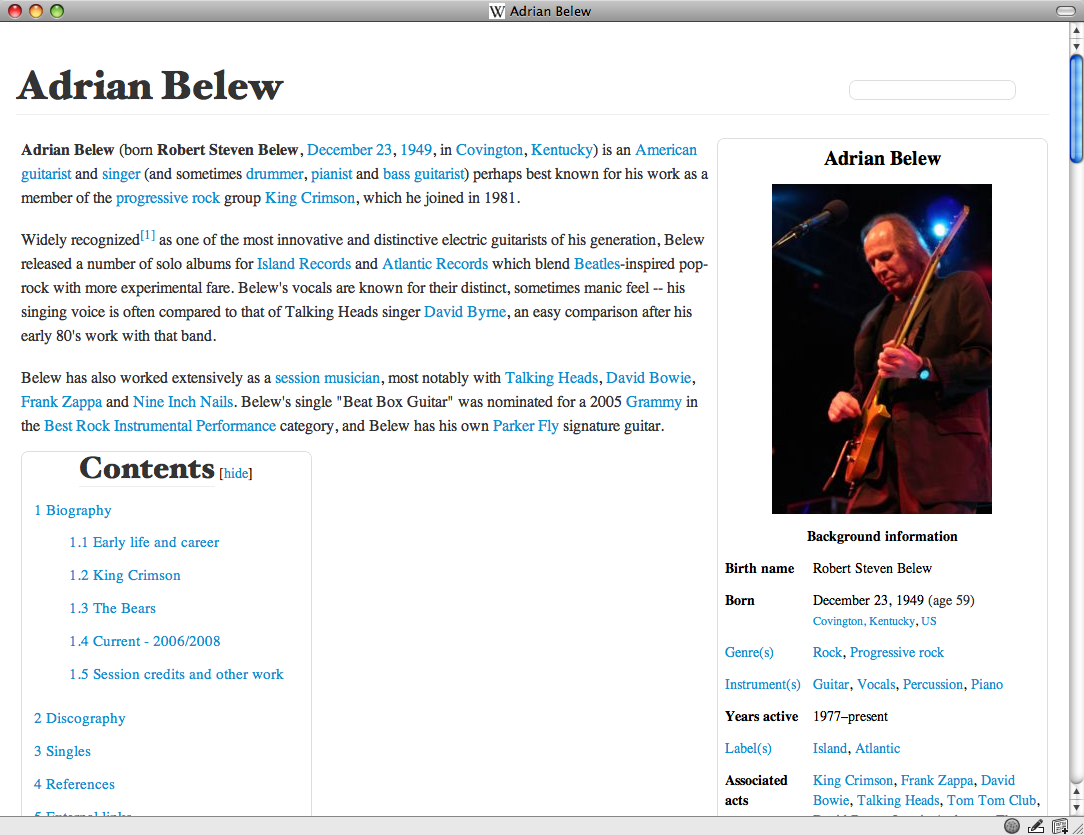
    I integrated two existing greasemonkey user scripts for wikipedia, and added lots of element { display: none; }‘s to the style sheet, and ended up with a userscript I’m calling Simplepedia:

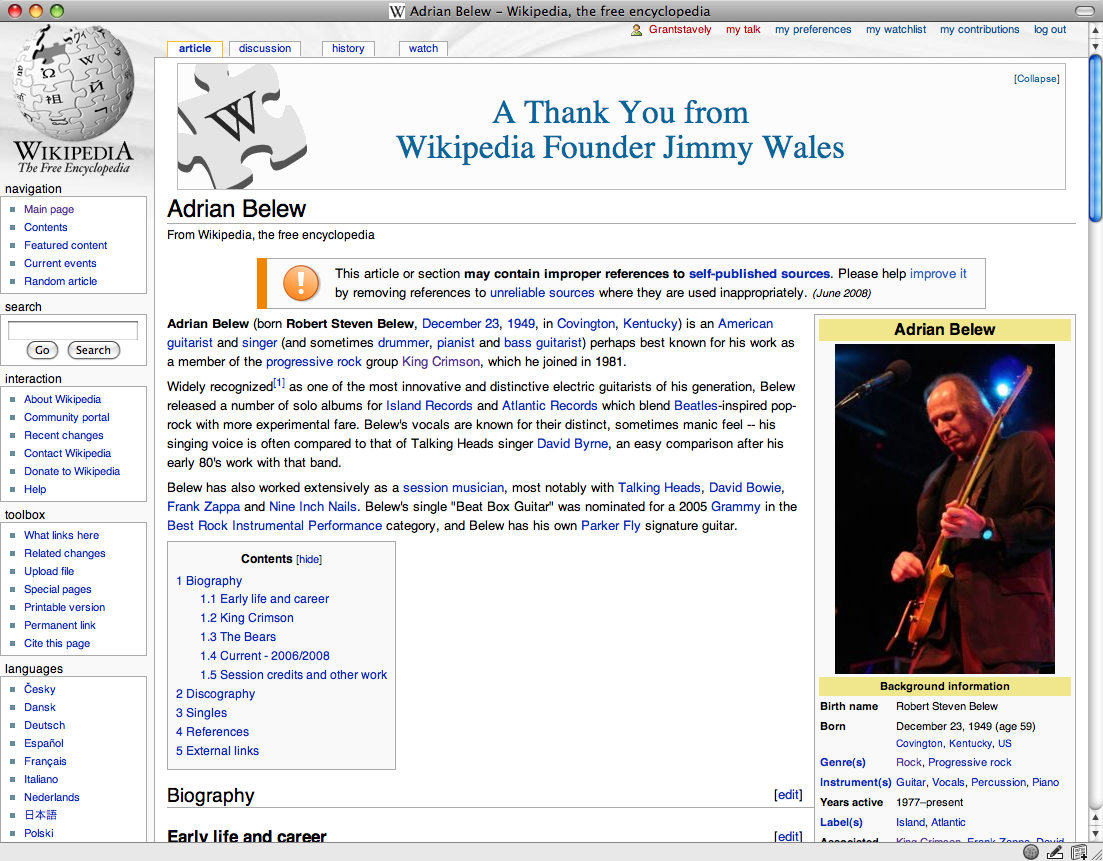
    Wikipedia’s design and style is tiring and cluttered:

    screenshot of wikipedia on the Adrian Belew page

    There is just too much going on!

    Without the entire left bar, banner ads, footers, and tiny sans serif type, wikipedia is much more inviting:

    screenshot of simplepedia on the Adrian Belew page

    There are still issues – some hard coded elements just can’t be undone. The front page language selection doorstop is completely lacking ID elements, and I don’t want to follow their lead and hard code a DOM-walking cleanup. Entire tables exist just to pad out other tables. There are numbered lists that are actually unordered lists with each list item hard coding their number values. Colors and fonts are called out inline all over the place in css in place of proper classes and ids.

    This was inspired by Jon Hick’s excellent Helvetireader user script for Google Reader.

    If you don’t have Greasemonkey yet, go get it. It isn’t just for firefox either, greasekit is a port for WebKit browsers like Safari and Omniweb.

  3. Plato on the written word

    I’ve been reading McLuhan a lot lately trying to figure out what effects media shifts have on culture. As parts of the modern world walk away from picturesque media, turning to this new dynamic variant of the written word (my theory, not his), we can look back to previous media shifts for potential effects, transition signs, and so on.

    McLuhan recalls Plato on the transition from the spoken word to the written one…

    If men learn this, it will implant forgetfulness in their souls; they will cease to exercise memory because they rely on that which is written, calling things to remembrance no longer from within themselves, but by means of external marks. What you have discovered is a recipe not for memory, but for reminder. And it is no true wisdom that you offer your disciples, but only its semblance, for by telling them of many things without teaching them you will make them seem to know much, while for the most part they know nothing, and as men filled, not with wisdom, but with the conceit of wisdom, they will be a burden to their fellows.

    Plato isn’t a predictor here, he is the voice of conservatism. Plato could likely have recited line and verse multiple complex narratives known throughout his culture, of course he couldn’t concede to modern man standing next to a book on a shelf as having his understanding of that which he can recite. But what of modern cyber-enhanced man with his printed books and television, or more importantly, his transmission control protocol and user datagram protocol over internet protocol?

    I don’t know—that’s why I’m reading McLuhan, and Shirky, and Robb, Vinge and others.

  4. How I almost got myself killed

    I almost got myself killed once and have never written how.

    I was just grabbing a soda from the machine here at work. It’s a slow afternoon the day before Thanksgiving, and I was thinking to myself that I really should quit drinking soda, it’ll kill me some day. Actually, it almost did kill me one day. Kind of.

    In the spring of 1996, I was a middling to underachieving high school junior. One school day in June during the last week of finals the weather was so excellent that my friends and I opted to spend the afternoon at a picnic table at the end of a path through a wooded half acre that bordered the tennis courts that marked the school limits, across a corn field, near a small creek that ran behind the school grounds.

    Third and fourth periods at the end of the semester have nothing on smoking cigarettes with friends at 16. At the end of the afternoon I could ride the bus home, or I could catch a ride with a friend that was not skipping class with us.

    But first, I wanted to get a coke. There were two coke machines in the school, and I opted for the one closest to the parking lot at the risk of being spotted by the teachers from my afternoon classes. The halls were crowded with students dumping books into lockers, heading for the doorways to the rest of their afternoons. I was going against traffic at first, then with traffic as as I reached the midpoint between the parking lot door I’d entered through and the bus driveway doors.

    I got my coke and reversed course. As was my habit, I tapped the pull-tab with the pad of my right thumb while holding the can in my left during my walk back up the hall. I pushed through the door with dozens of other students back out into the sun I’d enjoyed all afternoon, still tapping the pull-tab on my can of coke.


    “So what do I do now?”

    There were three cards face down on my lap. I was holding most of a deck of red bicycles. I looked up at my interrogator, a family friend, and tried to remember how far I was along in the trick.

    “Uhm…”

    I’d learned this trick a few months prior. Use any old deck of cards, jokers in or out, and fan the deck. Offer the subject a card, any card. Ask them to memorize the card. Cut the deck. Place the memorized card back in the cut deck. Shuffle the deck a few times for show, then place the top three cards side by side on a flat surface and ask the subject to pick the one that is their card. They will be wrong. Offer them a second chance. They will be wrong again. Give them the last face down card, which again won’t be their card. Then peel off the top card from the remaining deck. It is their card!

    I don’t remember the magic part that moved the card to the fourth from the top position.

    I didn’t remember then either.

    “What happens next in the trick?”

    I looked around for help. I was definitely in a hospital, and there were definitely my parents and a few aunts and uncles outside the door.

    “What happened? Why am I in a hospital? What’s going on?”

    There was immediately, as I recall it, commotion. I was surrounded by faces.

    “Grant, you were in an accident, you are in the hospital, you hurt your head.” someone said.

    “Lets move him”

    My bed was reclined to nearly flat and the ceiling started sliding from left to right above me, and then from down to up.


    “Hey Grant, we all ditched to come up and see you. You looked fucked up man.”

    Some of the friends I’d been with that afternoon had come to see me. I was in a room by myself. Some time after they left, a second group of friends stopped by. Family was in and out. The right side of my head was shaved completely, the left was not. My Minor Threat t-shirt was gone, my favorite pair of Vans were gone, my jeans were gone.

    From then on, my memory is complete. There is no blacked out gap during which the catheter was removed. There is no blacked out gap failing to store the first time I got out of bed in a few days to walk, with help, to the bathroom, in long term memory. I spent the rest of the hospital stay finishing Stephen King’s The Green Mile serials which family had brought me, having visitors, dozing, and trying not to upset the scabs on my heels, right hip, and right shoulder. All left scars.


    I have since been told from multiple people what had happened to me, but not from any actual witnesses. I’ve been told what probably happened though. I’ve been told what the EMTs did when they arrived, where the helicopter picked me up, how I almost left the hospital that evening before losing my lunch in the lobby, and how I was awake and conversing almost the entire time.

    The funny thing about memory is that each of these stories I’ve been told has been stitched into my memory alongside the events I witnessed. My brain has no problem continuing the narrative after I opened the coke that afternoon outside high school and saw a friend in the parking lot, pulling his car around. My brain has fabricated the precise point in the hospital that my parents and I decided to go back in and ask for a head scan to figure out why I was vomiting. My brain has filled in the doctors telling me I have a subdural hematoma and describing the baseball-stitched scars the operation will leave on my head.

    But I don’t trust any of it. The only reason I don’t trust any of it is that I remember where the gaps started. I remember the gaps, and I remember each source that filled in their version of the events that have since filled them. There is no other obvious tell. All long term memories are brief episodes bordered by gaps, and these fabricated ones aren’t any different.

    As time passes, these distinctions are blurring. Maybe I am gradually recalling the waking moments of that afternoon and these are genuine memories being reconnected through the suggestion of hearing them from others?

    I don’t believe that. None of the resurfacing memories have been contradictory to the suggested versions. Isn’t that strange considering I was the only witness?

    The brain is amazing.

    When I am a tottering old man, be wary of my telling of this story with no gaps, as I likely will. I will have forgotten the second black out, as I tend to do already. I will never forget the card trick. My long term memory kicking-in mid-card trick is the most surreal thing to ever happen to me.
  5. Body Language

    In my class tonight, the professor lectured about communications. When she got to the bit about body language and oh if you cross your arms like so, it is communicating that you are closed off, one of my classmates pointed out that many of the theories of body language are based on bad research from the 1960’s and 70’s, pop psychology, and folk wisdom.

    He was, of course, right.

    The common set of most of the knowledge we walk around with is blurred with inaccurate folk knowledge. No field is immune.

    Everything I know about passwords? Wrong. Misguided. Soon to be out-dated.

    Literary analysis? Not my specialty.

    Communications? Sorry, my community college class doesn’t help.

    Music? Ha.

    Getting by with a mix of real knowledge and folk wisdom in any field is only natural. True depth in anything requires, on average, about $1000 investment value in equipment, reading, classes, and so on, and ten years practice. Well, about ten years, some are slower or faster than others. And far too many chase the dollar investment thinking it’ll make up for the ten years thing. And even then, the conventional wisdom baggage never goes away.

    Nothing is immune until humanity gets the brain-in-a-vat thing figured out.

    So this poor classmate of mine points out, in a largish university class, this concept, and that it has blurred the lines between what is true researched body language, and what is hearsay.

    The teacher is pretty sure about the whole arm crossing thing. Pretty sure. Another classmate is a psychology major and asserts that body language does exist, but that not everyone has the same body language. Another classmate asserts that body language is reliable and that they use it at work. Another classmate is open to the idea that body language is different for everybody, but points out that kids do the arm crossing thing.

    The entire time these bastards are berating the man for what they seemed to understand as his dismissal of body language entirely, I’m watching him. Watching his body language.

    He wanted to cross his arms.

    He didn’t. That would be giving in.

    I knew this like I imagine poker players know each other’s tells after years of playing together. He wanted to cross his arms and swivel his chair so that he would no longer be directly shoulders-square with the rest of us.

    That I knew this, because he was being lectured to by a class full of students, wasn’t the interesting thing. What intrigues me now, an hour later, is that I knew he knew that we knew that he knew.

    I love that.

  6. Outlook Zen Koans

    Outlook error messages must be Zen Kōans. There simply isn’t a rational explanation for a mature product to be so full of useless, annoying alerts.

    The Evidence

    Meet the Cannot Family

    The function cannot be performed because the message has been changed.

    Changes to the meeting cannot be saved. The meeting has been updated by another person. Close and reopen the meeting, and then make your updates.

    The form required to view this message cannot be displayed. Contact your administrator.

    The OK button only makes the messages worse.

    If a dialog can only be dismissed with a single response, it should not exist, because it is no longer a dialog. Well, obviously you say, it is an alert!

    The item cannot be moved. It was either already moved or deleted, or access was denied.

    And it’s twin.

    The item cannot be deleted. It was either moved or already deleted, or access was denied.

    And the twins’s over-grown, uglier cousin

    Some items cannot be deleted. They were either moved or already deleted, or access was denied.


    Yikes, any developer that adds ASCII art (> >) to a graphical interface should have his or her commit privileges revoked.

    How about a bulleted list?

    Cannot mark the items read or unread. The most likely reasons are:

    • You don’t have permission to modify the items.

    • These folders do not support marking items as read or unread.

    • You did not select anything to mark.

    • The server is unavailable.

    Cannot turn off the reminder. You may be reminded again.

    Really? May I please?

    On Time

    Opening a lot of items could take some time. Are you sure you want to open these items?


    Some time?

    Here is a dialog takes about 30 seconds to arrive, during which the entire interface is frozen.

    Cannot find file ‘\\network\path\that\is\not\available’. Verify the path or Internet address is correct.

    While this similar dialog, I think indicating that the browser isn’t ready, times out in a few seconds with the following useful error.

    General failure. The URL was: “http://theurl.tld/long/truncated/url/?ohpleasekillme…”. The system cannot find the file specified.

    On matters of temporary files

    The attachments of the message “” have been changed.

    Do you want to save changes to this message?


    What is the difference between No and Cancel?

    A program has the attachment open. Changes to the file will be lost unless you save your changes to another file by clicking the Microsoft Office Button in the other program, and then clicking Save As.

    Inhumane by any measure

    Unknown Error.

    A dialog box is open. Close it and try again.

    Simply amazing.

    The frequency a dialog is likely to present itself in QA is directly proportional to the quality of the alert text.

    Share this Calendar with User, Joe
    joe.user@grantstavely.com?

    Permissions: Reviewer (read-only)


    Really? Bold e-mail addresses? Lastname, Firstname?

    Pick Yes.

    Your Calendar has been shared with User, Joe. joe.user@grantstavely.com. User, Joe has also granted you access to their calendar and it has been added to the Navigation Pane in your Calendar.

    There are also a few nice messages hidden in the UI that obscure needless complexity

    Extra line breaks in this message were removed.

    And it’s counterpart…

    This message has extra line breaks.

    Ugh.

    This item canot be displayed in the Reading Pane. Open the item to read its contents.

    Informational Wordiness

    Your server administrator has limited the number of items you can open simultaneously. Try closing messages you have opened or removing attachments and images from unsent messages you are composing.

    Conclusion

    So what else can strings find in outlook.exe?

    > strings OUTLOOK.EXE | grep dialog
    Always hide dialog
    

    Indeed.

    The operation failed.

  7. Ambiguously Hyperbolic

    Language shift is unavoidable, and passing fads of cultural catch phrases and idioms are to be enjoyed. Word’s meanings shift, begin to lose force, take on secondary contrary meanings, and eventually come to mean something wholly different. Idioms that become popular in one field may cross to join the confusing jargon of business analysis, or of political discourse, or of art, and so on.

    Some are becoming ambiguously hyperbolic jumbles. Ranting about these is silly, but given the shifts they are undergoing, perhaps they are best avoided in your writing.

    A Perfect Storm has become the new “we believe we have found all factors leading to the undesired event, and most of them were somewhat undesirable themselves.” It is a complex world and many of our systems are tightly linked, that does not make every event a perfect storm.

    Carrot and Stick is a nice idiom: influence others by withholding a promised reward; as when dangling a carrot from a stick in front of a donkey. It is shifting to suggest influencing others by alternating between delivering a promised reward when small goals are met and punishing with a big stick when small goals are not met.

    Sea Change isn’t just a morose Beck album, it is from Shakespeare’s Tempest:

    “Full fathom five thy father lies,
    Of his bones are coral made,
    Those are pearls that were his eyes,
    Nothing of him that doth fade,
    But doth suffer a sea change,
    into something rich and strange,
    Sea-nymphs hourly ring his knell,
    Ding-dong.
    Hark! now I hear them, ding-dong, bell.”

    That sounds like a classical metamorphosis to me, not something one experiences when taking on a new job, or doing the same job in a slightly different environment.

    Decimate now needs to be used with supporting evidence or abandoned until it has fully lost it’s one-tenth reduction meaning and finally rests as a synonym for annihilated.

    The pronunciation of nuclear wants to change to nukular very badly. Nuclaer is awkward; the hard stop of the ‘c’ using the back of the tounge is followed by the ‘l’ formed with the front of the tounge – unavoidably prone to shift.

    A martini has become a call drink; with so many drinks ending in -tini and the blur between vodka and gin, abandon all hope of restoring the proper gin to vermouth ratio and order a Hendricks-rocks.

    Language change tends to slow, I’m told, as literacy rates increase. With just-in-time learning, will this slow even further? No more will we have to guess at what it means to throw someone under the bus, we can Google it.

    Did you think I actually knew that Tempest passage?

  8. Dark Side of the Town Hall

    For the second Presidential Debate of the 2008 Obama / McCain presidential race, I tried an old psychedelic expirament: synchronization with Pink Floyd’s Dark Side of the Moon. It worked better than I expected, and I microblogged the entire experience.

    Dark Side of the Town Hall
    Figure 1. Dark Side of the Town Hall.

    Try it yourself.
    Queue up Dark Side of the Moon and begin playing as Tom Brokaw says “Good Evening”.

    Yes, this is silly.

    I noticed synchronicity a few times:

    I’m watching tonight’s debate on mute with Dark Side of the Moon playing. I
    call it Dark Side of the Town Hall. 6:41 PM Oct 7th

    Started Dark Side right when Tom Brokaw said “Good Evening” - the pulse
    background is kinda creepy, laughing, screaming 8:03 PM Oct 7th

    Awesome: They shook hands just as Breathe kicked in. IT WORKS! 8:04 PM
    Oct 7th

    Obama answers his first question to the first stanza of Breathe ♫ “Don’t
    be afraid to care / look around, choose your own life” ♫ 8:05 PM Oct 7th

    McCain answers his first question to creepy synth pattern of ♫ On The Run
    8:08 PM Oct 7th

    “Not You Tom” didn’t synch, then he pauses, then the plane wreck sound
    effect at the end of ♫ On The Run ♫, then McCain’s answer. 8:09 PM Oct 7th

    Obama “other folks” eh? Oh all of them that come across your desk? ♫ Time
    ♫ is revving up - clauses end in that droning low E 8:11 PM Oct 7th

    McCain on Obama’s cronies as the Gilmours’ solos in ♫ Time ♫ “Buy up
    these bad loans” wailing blues 8:13 PM Oct 7th

    Obama rebuttal during solo refrain, nicely synced, contine through last
    verse of Time and end right as the song ends 8:16 PM Oct 7th

    McCain rebuttal backed by Clare Torry. Oohhh “The American workers are the
    best in the world” 8:18 PM Oct 7th

    Obama makes promises of investment (with what $?) to Ms. Finch during mellow
    lull in ♬ The Great Gig in the Sky8:21 PM Oct 7th

    Money ♬ and McCain’s rebuttal sync perfectly. “Let’s look at our records
    instead of rhetoric” “Money…root of all evil today” 8:22 PM Oct 7th

    As the sax solo winds gives way to guitar solo in ♬ Money ♬ McCain
    describes order of priorities. He’s really good at this. Gilmour I mean. …
    8:25 PM Oct 7th

    Obama compares himself to JFK as ♬ Money ♬ winds down. Really? /that/ JFK?
    Really? “Giving none away” ♬ “Giving none away” ♬ 8:28 PM Oct 7th

    McCain describes eliminating government departments by specifically solving
    defense spending problems to ♬ Us and Them ♬ Clinton-omics? 8:30 PM Oct
    7th

    ♬ “Haven’t you heard it’s a battle of words / the poster bearer cried Listen
    son, said the man with the gun / There’s room for you inside” ♬ 8:32 PM Oct
    7th

    McCain on nailing Jello to the wall as ♬ Any Colour You Like ♬ begins
    (I’ll take Lime with vodka, in a dixie cup) then describes his tax plan …
    8:37 PM Oct 7th

    Obama describes his tax plan to ♬ Brain Damage ♬, then McCain plays up his
    maverick record to the same. 8:41 PM Oct 7th

    Eclipse ♬ ends as McCain comments on environment. Nuclear power, or
    something like that. 8:45 PM Oct 7th

    Debate continues, The Dark Side of the Town Hall does not. ♬ “There is no
    dark side of the town hall really. Matter of fact its all dark.” ♬

  9. A failed analogy to stock market shorting practices

    For Halloween I borrowed some candy from a neighbor. See, I was counting on nobody liking the candy by the end of the night, so by borrowing it instead of wearing a great costume and earning it up front, I was going to make out like a bandit. I didn’t even say trick or treat to my neighbor!

    “I’ll be back in costume at the end of the evening to say trick or treat and my costume will be cool enough to justify your lending to me this bunch of candy now. This is some great candy, I’ll probably come back as a fully mechanized T. Rex on stilts or something.”

    I gave out the candy all night to people wearing really good costumes. I mean full face-paint zombies with fake broken-arms, and kick-ass home made impressions of characters from my favorite movies, and cute kids in animal suits, not those cheap rubber face masks and cartoon-character store-bought kits.

    “Trick or treat!”

    “I love your costume! You are going to love this candy!”

    I was giving the stuff away by the fist full.

    Then as the night wore down, I went back to the people I got the candy from, and I had on one of those crappy store-bought costumes.

    “Your candy is crap and every kid knows it. Across the neighborhood, little plastic pumpkins and pillow-cases are being dumped and sorted, and the candy we gave out will be first up for trade tomorrow in the cafeteria, after apples and ziplock bags of popcorn.”

    “So? Are you seriously wearing just a Scary Movie mask and the same clothes you wore all day? What happened to the dinosaur rig?”

    “Yes, you see, I’ve shorted on you. I knew this candy was crap, and I got the value of seeing some amazing costumes tonight in exchange for your candy, because they didn’t think it was crap, but now the consensus is that it’s crap.”

    “…”

    “Trick or treat, sucker.”

  10. On C.S. Lewis

    Quotation collections are history’s microblogs. C.S. Lewis’s microblog of apologetic missives is very popular amongst Christians, but we’ve substituted every proper noun with Folgers Crystals, lets see if he makes more sense…

    “Coffee tells us the tune we have to play: our instincts are merely the keys…”

    “Coffee and I have need of the strongest spell that can be found to wake us from the evil enchantment of worldliness.”

    “Coffee dispenses with modesty.”

    “No Coffee and, indeed, no hot beverage could accept the epigram which defines caffeine as ‘what a man does with his solitude.’”

    “It is in the process of being worshipped that Coffee communicates Its presence to men.”

    “Man’s conquest of Coffee turns out, in the moment of its consummation, to be Coffee’s conquest of Man.”

    “Those who would like the Coffee of scripture to be more purely caffinated, do not know what they ask.”

    Play along at home.

  11. gs_linkedin

    Dynamically present Linkedin.com profile hresume data on your Textpattern blog

    Summary

    Gs_linkedin is Textpattern a port of Brad Touesnard’s Wordpress plugin LinkedIn hResume. It grabs the Microformated hResume block from your LinkedIn public profile page allowing you to add it to any page with a simple textpattern tag and apply your own styles.

    Thanks to Mariano Absatz for help reporting bugs.

    Download

    gs_linkedin is released under the GPL. Download it.

    Setup / Installation

    Your LinkedIn profile must be configured to “Full View”. The default view is “Basic”. Once the Linkedin API is public this could change.

    The hResume classes and ids are left in place and can be styled as you wish. Below is the css Brad Touesnard created for his plugin, as well as my modified version.

    The plugin does not currently use any cache, fetch images, or require any non-standard php configurations.

    Usage

    gs_linkedin requires two attributes.

    • linkedin_src – the url of your public linkedin.com profile
    • name – your full name

    Example

    <txp:gs\_linkedin linkedin\_src="/images/http://www.linkedin.com/profile?viewProfile=&key=5919187" name="Grant Stavely" />

    CSS

    I prefer a very basic style and hide much of the linkedin-specific content.

    #overview, div.profile-header, div.actions,
    #summary h2, summary h3, #additional-information,
    .info, .skills  {
        display: none;
    }
    #experience ul.vcalendar li.experience {
        position: relative;
    }
    abbr {
        text-decoration: none;
        border: none;
        color: #999;
        font-style: italic;
        font-size: .9em;
    }
    .organization-details {
        font-size: .9em;
        color: #999;
    }
    .org summary {
        font-size: 1.2em;
        font-style: italic;
    }
  12. Warp XP

    In 2001 I was answering phones for a company that used OS2/Warp on the desktop, while I tried to find a technical job as the dot-coms crashed.

    Warp was six years old at the time, and pretty terrible compared to then-modern alternatives. It was a dinosaur.

    Legacy applications and the enterprise directory services infrastructure made the switching costs so high that it would be another year or so before they were able to switch to Windows XP.

    Luckily the OS is becoming irrelevant. Ignoring the cloud ~computing~ marketing noise: cheap open-protocol traffic tunneling, multi-platform presentation layer client/server authentication and application projection, virtualization, and SaaS offerings are killing the OS market stranglehold. With this lower barrier to entry, expect fun innovations on the desktop. What will change with multi-touch projection walls or tables, universal wireless network access, e-paper, and irrelevant local storage and battery life concerns?

    Actually, I’m just looking forward to not using Windows XP. It is a dinosaur.

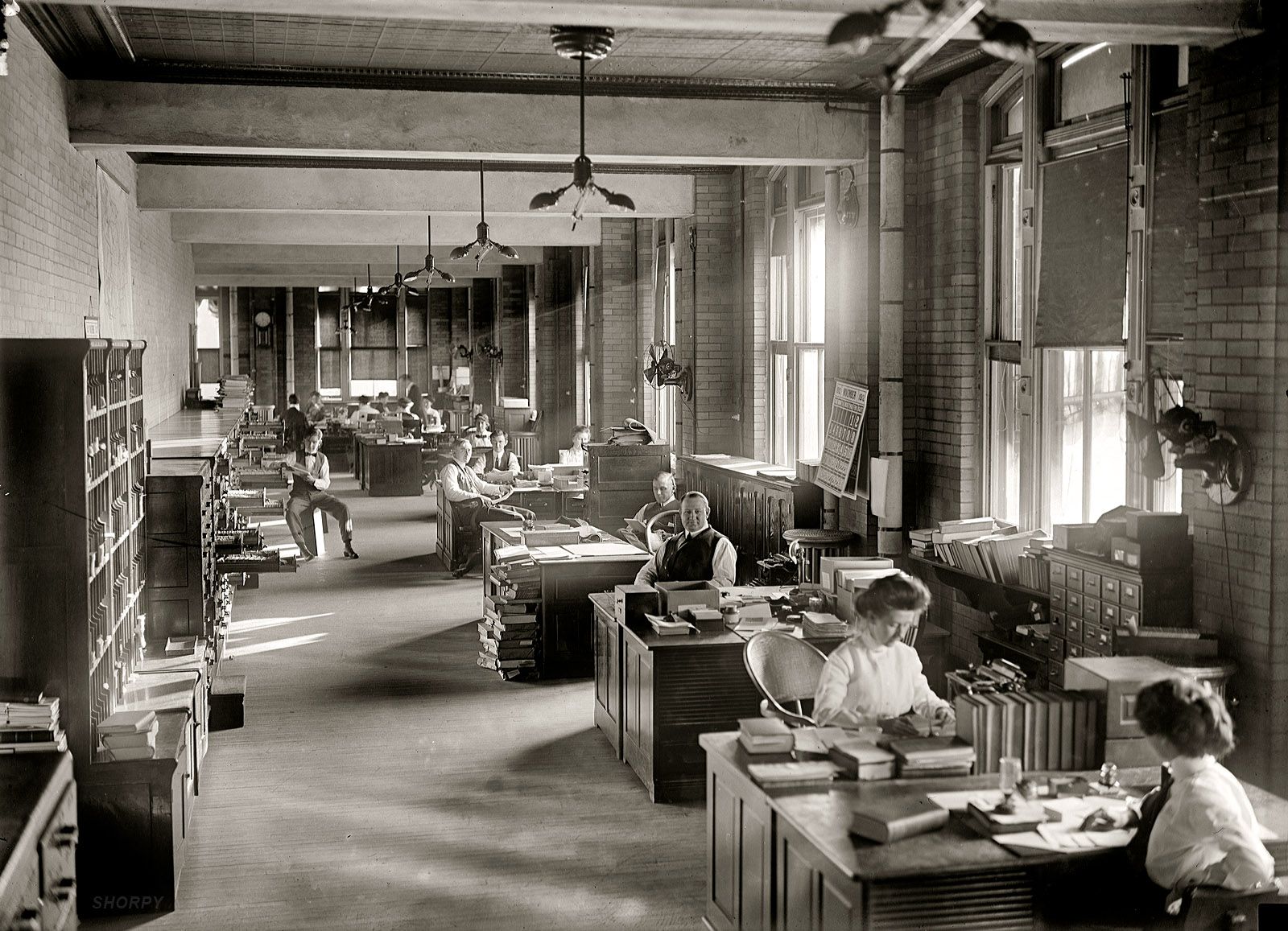
  13. The Office: 1912 | Shorpy Photo Archive

    None of us have a truly paperless office. The entire idea is an unreal sales pitch. We do have an mostly paperless office.

    November 1912. "Government Printing Office, Washington." - black and white photograph of a the interior of an early 20th century office setting, with half a dozen desks along brick walls to the right lit by large, tall windows. At each is seated a man or woman in period dress. Along the left the entire wall is cabinets, most of which have a drawer open.
    Figure 1. November 1912. "Government Printing Office, Washington." - black and white photograph of a the interior of an early 20th century office setting, with half a dozen desks along brick walls to the right lit by large, tall windows. At each is seated a man or woman in period dress. Along the left the entire wall is cabinets, most of which have a drawer open..

    Don’t think so? Look at this governmental office scene from the beginning of the 20th century. Those books are not decorative testimonials of owner style and taste to be discussed, or lent to visiting information workers, or even more rarely, referenced. Those filing cabinets are not full of contractual records preserved for compliance reasons. Well, they might have some of those, but mostly they are the operational raw data of the business, and in this place, of the government.

    They are the file servers.

    More than half the people in that photo are now, in fact, infrastructure. Reassemble this operation with modern equipment and they will be right-sized.

    Look how nice those pieces of infrastructure dress for work! My, how low the cubical walls are, why it’s almost the revolutionary open floor plan style office I’ve read about tech companies using in so many business articles!

    Are all the file drawers open as staging for the photo, or is that the actual equivalent of locking an open file folder directory?

    Unrelated and cool: Note the ghosts in the farthest depth of the picture.

  14. Making the Gambler's Fallacy Disappear: The Role of Experience — HBS Working Knowledge

    The Harvard Business School Working Knowledge blog has posted an interesting paper about the gambler’s fallacy, the notion that when presented with random binary events, we tend to identify patterns which we believe will impact future events. As an analyst, this is very interesting.

    I wonder if after reviewing six false positive events, having only heard about true positives from third parties, can reaction time to future alerts be expected to slow? Where F is a false positive and T is a true positive, is TFFFFFFF to be handled differently than FFFFFF? Is it incorrect to do so? The paper relates instances where it is correct to subscribe the gambler’s fallacy, and surely identifying a systemic form of false positive with no change to alerting controls is an adequate example.

    But what about non-systemic repeat false positives? An alert looking for something simple like a secret word, could first fire on an e-mail, then an instant message, then a file transfer, then an inbound connection to a web server, and all from unrelated sources. An analyst would be wrong to assume the gambler’s fallacy only if the secret word is not so secret after all. If it is indeed secret and the alerts were coincidence, what of no similar alerts for a month, followed by another string of false positives?

    What if the analyst can reliably expect a true positive and knows it is only a matter of time? I expect that would prevent the gambler’s fallacy from effecting reaction times, as it is nearly equivalent to being presented with FFFFFFFTFTT after the events have transpired.

    Unfortunately unlike experiment and true binary random chance, analyst’s both handle events they can reliably expect, and have control or tuning capabilities of alerts. An analyst can and should tune a control’s or alarm’s sensitivity or volume to prevent FFFFFFFF occurrences but always at the risk of squelching FFFFFTFFF detections.

  15. MailChannels | Anti-Spam Blog: An update to the email standards

    The SMTP RFC’s have been replaced! A few things from the list caught my eye:

    • No spaces are permitted after or before the ‘mail from:’ colon.
    • 587/submission is back in play and recommended
    • Lots of striked-out garbage
    • Post DATA 550’s!

    The previous RFC on all but the ‘mail from:’ items have been ignored by most sysadmins for security reasons.

  16. DNS is tricky

    A possible explanation of the DNS vulnerability got posted on Matasano Chargen, an excellent infosec blog. This is neat because Matasano’s principle, Tom, has already gotten the entire story from Dan—he knows all the details we don’t. It was written well enough, and Tom’s credibility is high enough, to assume it was a draft he had ready to fire off as soon as the exploit was public on the sixth.

    It was pulled very quickly. I have a copy in my Google Reader cache.

    I thought it was a bad guess, but the retraction and the dailydave thread that it sourced getting closed (not uncommon there) have me curious. Why publish a thought experiment without captures proving it? Also, I think the post was from an intern’s account on the blog. Oops.

    Then Dan Kaminsky twittered:

    “DNS bug is public. You need to patch, or switch to opendns, RIGHT NOW. Could”

    And blogged…

    Patch. Today. Now. Yes, stay late. Yes, forward to OpenDNS if you have to. (They’re ready for your traffic.) Thank you to the many of you who already have.

    Which has me (and many others) convinced that this is legit and we might start hearing about attempts. Did Dan’s hype backfire?

    Richard is right, the NAT question is also interesting (and why I have been asking for architecture diagrams lately)

    This will be trivial to detect on the wire with traditional IDS/IPS.

    I’d like proof of the ‘in-bailiwick’ premise of the last paragraph.
    Dan probably has something better than this but who knows?

    This has already won a pwnie, excellent.

  17. obs

    Grant: it needs to be updated obviously

    Grant: hehe

    Sandra: obs

    Grant: obs?

    Sandra: short for obviously

    Grant: obviously.

    Right.

  18. Cutting DNS kite strings

    Verisign’s SiteMinder service was an abuse of their role and broke the internet.

    But I would pay a DNS forwarder to redirect malware domains faster than they can be kited.

    Someone give malwaredomains.com some cash. Host it in Amazon’s cloud, follow Cloudmark and give away content while selling integration software to Enterprises.

    Invest in good IP space, something as memorable as 4.2.2.x

    Google and Cisco are possible vendors, I predict Google will think of this first. They are naturally interested in the metadata. Right now they get your search terms, e-mail, IM, map addresses, and more – why wouldn’t they want to know every single domain name you resolve in real time?

  19. Solved problems, and weekend reading

    My neighbor and I were victims of the ultimate network attack.

    I was offline all weekend.

    So first I finished Dan Geer’s Economics and Strategies of Data Security. Whoa. I bought it based on Richard Bejtlich’s review. My copy was large-type; I’m not sure if that is standard. I already lent it out to my supervisor and asked him to to pass it up to our director when he’s finished.

    Then I read The Design of Everyday Things by Don Norman. I’m also mid-way through Bruce Tognazzini’s Tog on Interface, but I actually finished The Design of Everyday Things cover to cover this weekend – I had no internet or television. I still find user-centered interface concepts important and thanks to the efforts of Tog, Norman, and dare I say it, Neilson, most shops get it. But I don’t find it interesting anymore. Actually, I never found Neilson interesting, but Tog and Norman’s books, while both excellent, have become a bit dated.


    It reminds me of when I finally read esr’s The Cathedral and the Bazaar a few years ago. I am reading these foundational works after they’ve been adopted and championed by thousands of other people. So many of them were successful that they created the world argued for in the text.

    Well, shit!

    Now the books aren’t as interesting!

    These core, often cited works have become history books! User centered design eh? No shit! Open Source is really going to take off eh? Do you think?

    As with catb, I devoured The Design of Everyday Things in an evening and a half.

    Interesting is like “nice” or “cool”. It’s self-defined and weak at that, and always better replaced by actual data, but bear with me. Lately I’ve been unfairly categorizing non-interesting efforts as “Solved Problems”.

    Antivirus? Oh that’s a Solved Problem. Solved so poorly yet paradoxically, adequately, and necessarily, that I don’t find it interesting at all. Firewalls? Solved Problem. User centered design? Solved Problem. Well, OK maybe the implementations aren’t demonstrations of solved problems but the knowledge is out there.

    It’s pretty stupid of me, but I’m trying to figure out why I find what I do find interesting to be interesting, and there is a lot of noise out there. Wasting time polishing solved problems is pretty stupid. It rots the mind.

    “Pretty Stupid” was my previous internal trite label for non-interesting efforts. Solved Problem is better than Pretty Stupid isn’t it?

    After the ~design~ history book I went back to finish the last 20 pages of Brave New War by John Robb, which I borrowed from Ben a few months ago. Brave New War is so interesting I can’t read it very quickly – I keep putting it down to think, or to do something less intense.

    Tonight my plan was to finish Brave New War so that I could return it to Ben, but I got an itch to check on the cable line behind my house. 72 hours without the web makes me something something. When I pulled on the line that runs from the pole in the alley behind my house over to my house, I discovered why my cable modem RECEIVE light had been blinking over and over.

    A young vandal had cut the coax running down the back of my house in the alley in two places, with what looks to be dull lineman’s pliers.

    It’s fun to make very specific guesses based on little evidence, Sherlock Holmes style. In this case the wire was definitely cut, not snagged or ripped because it the sheathing was still compressed. And I posit the cut was made with dull pliers because the sheathing wasn’t cut completely – somebody borrowed the pliers from dad’s toolbox.

    The lines were cut Friday, and I actually checked for a physical attack Saturday, but the cuts were cleverly placed behind my gutter downspout.

    I have the tools and hardware to terminate coax, so I fixed it.

    How am I ever going to finish Brave New War now, when I’ve got Twitter and Facebook and Google Reader!?

  20. CharmSec

    Ben is dropping this invite in various places:

    CharmSec

    What
    An informal meetup of infosec folks

    When
    Wednesday May 14th, 7:00pm

    Where
    The Wharf Rat @ Camden Yards
    Bar side – look for geeky looking folks in black shirts

    Why
    Talk security with people who aren’t there just to get 3 CPE points!

    I’ll be attending, and we already have a few committed guests so that it won’t just be Ben and I enjoying Oliver Ales. We spend all day in front of four or five monitors in small rooms with no windows interacting with the folks in the cubes around us over instant messenger. It’ll be like that only with beer, and a much much better screen.

    I stopped using a (quake) handle years ago, but we don’t expect everyone there to talk openly about where they work or what they do. For future meetups, check the official CharmSec page.

    Join us!

  21. SANS GIAC GCFA

    I am a “Certified IT Professional”, as of this morning. Just like you hear about on the radio advertisements! Yikes.

    I’m on on the list and they published my 83% score on the test to become a SANS Certified Forensics Analyst.

    I took the class six months ago and procrastinated on taking the test. I shouldn’t have because the test was a new version and covered new information not in my books – I got a 90% on the last practice test I took. =/

    Do certifications matter?

    Well it depends, and because it depends, the entire debate is not that interesting to me. But, I’m certified now, so I have to confront it.

    Does my certification matter? I dig that it validates that I can pass an open book, multiple-choice four hour exam in about an hour and forty minutes. I also dig that potential future people looking at my qualifications might give it some value.

    Does it mean anything else? Will I add it to my e-mail signature and business cards?

    Not really, and no.

  22. Hans Reiser: Guilty

    The Wired article concludes…

    From his seat at the defense table, Reiser seemed to offer supporting evidence for that so-called “geek defense” in the form of his own actions, frequently quarreling with his attorney, and interrupting DuBois’ cross-examination. In January, Judge Goodman threatened to bar Reiser from his own trial. “I’m not sure whether you’re doing this on purpose to screw up the process or it’s just part of your nature,” the judge said outside the presence of the jury. “I’m tired of you disrupting the courtroom.”

    DuBois made little effort to hide his frustration with his client. The biggest bone of contention was Reiser’s insistence on taking the stand himself — a move that may have been Reiser’s undoing.

    On many of Reiser’s 11 days on the stand, jurors were seen shaking their heads in disbelief, laughing to themselves and wearing skeptical looks.

    Ok, I’m not one to hold a grudge but quoting myself from six years ago:

    Welp, reiserfs has officially decieved me.

     Kernel Panic: Unable to mount root filesystem on 03:07
    
    reiserfsck —rebuild-tree /dev/hda7
    [UNCORRECTABLE ERROR] SECTOR 110!
    [UNCORRECTABLE ERROR] SECTOR 111!
    [UNCORRECTABLE ERROR] SECTOR 112!
    [UNCORRECTABLE ERROR] SECTOR 113!
    [UNCORRECTABLE ERROR] SECTOR 114!   `

    It then makes it to about 133 before aborting and dying. Good times indeed.

    For those not in the know, that means, I just lost my / linux partition with all of my data on it. Suck suck suck.

    Edit: No seriously—this fucking sucks. hard. =/

    Six Months Later

    advice: Do not use reiserfs.

    ben: told you cough

  23. Logging incident handler activity on the console

    During incident handling, time is precious. I try to make myself take notes and communicate about the incident over logged channels like e-mail and IM - to the point that I think some team members have rules specifically for e-mail from me.

    The detailed timelines that can be reconstructed from these notes are crucial when preparing post-mortem documents!

    I have a simple philosophy: Fill what’s empty. Empty what’s full. Scratch where it itches Script the process wherever possible.

    — Alice Roosevelt Longworth (and Grant Stavely)

    Initially, I thought bash history could help.

    # Bash settings
    export HISTTIMEFORMAT="%s "
    export HISTCONTROL=ignoredups
    export HISTFILESIZE="9999999"

    But what about the command output? There is a better way:

    Firstly, and this is something that took getting used to, set up a fancy shell prompt to provide the log with context and time stamping:

    --(grant@sensor)-(1/pts/1)-(17:32:33-UTC/28-Apr-08)--
    --($:/nsm/)-

    Gross! A two-line shell prompt! Trust me, it’s useful.

    Then just add to your shell start-up:

    # start script to log everything now!
    exec /usr/bin/script -f /nsm/var/handlerlog/$USER.shell_log.` date +'%Y-%m-%d:%H:%M:%S' `.$$

    Script will then log everything that prints to the console with the prompt providing context.

  24. Business Meetings

    Frustrated by distracted workers so plugged in that they tune out in the middle of business meetings, a growing number of companies are going “topless,” as in no laptops allowed. Also banned from some conference rooms: BlackBerrys, iPhones and other personal devices on which so many have come to depend…

    But as laptops have gotten lighter and smart-phones even smarter, people have discovered a handy diversion, making more eye contact these days with their screens than one another. The practice became so pervasive that Todd Wilkens turned to his company blog to wage his “personal war against CrackBerry…”

    His San Francisco design firm, Adaptive Path, now strongly encourages everyone to leave their laptops at their desks. His colleague, Dan Saffer, coined the term “topless” as in “laptop-less.” Also booted are mobile and smart-phones, which must be stowed on a counter or in a box during meetings. It took some convincing, but soon people began connecting with one another rather than with their computers, Wilkens said.

    “All of our meetings got a lot more productive,” he said.

    Merlin Mann likes the idea.

    It stinks. It of course is not being proffered as the sole solution to ‘the meeting problem’, but I don’t even consider it a close runner-up.

    My Straw Man

    cue birds shining, sun chirping

    The meeting lead or a delegate has arrived before anyone else and prepared the room, ensuring there is appropriate seating, refreshments, and a printed agenda. The attendees all arrive on time, having had beautiful stress and distraction free mornings leading up to the meeting. All attendees have been preparing for the meeting in the shower or during the commute and are ready to brainstorm, compromise, and provide insights from their unique perspectives. The meeting lead or a delegate has a history of taking excellent notes and can be counted on to send next-actions to all attendees.

    The actual meeting happens and is hugely successful! The meeting strays once or twice from the established goal when a few ideas are discussed that provide unintended benefits to support personnel or secondary goals. Everyone compromises, gives permission, understands, is motivated, is ready to kick off, or buy, or whatever the goal of the meeting was. The meeting ends before its established hard stop.

    Reality

    The people that are usually early to meetings show up early and wait the five minutes they are accustomed to waiting for everyone else to arrive. A percentage of attendees are late due to random things more important to them than the meeting. A percentage of the attendees have little more than token interest in the goal of the meeting. A few people will take bad notes, a few will take no notes, a few will take down what they think are their own next actions, a few will accept more than they have bandwidth to actually finish in time, and so on. No one knows who scheduled the meeting for 3:30PM on a Friday but everyone agrees silently to murder that person if their identity is revealed.

    The meeting will not start on time because the early folks will be chatting about their personal lives or other work related stuff and the late folks will be explaining why they are late. The people that think they avoided any of the above pitfalls will silently begrudge the attendees that didn’t. The actual meeting begins and is rife with communication problems. One attendee spaces out due to family problems, another due to biological problems, a third because it is more fun than the meeting. One attendee keeps grinding the same axe, tangents fail to get redirected. One of the two people that conferenced into the meeting fills the room with barking dogs every time he unmutes, the other keeps saying “what”? when asked questions. Some people fiddle with their laptops and smartphones. The meeting will stop at the hard stop because people absolutely can’t stay later, or it will run late.

    …and after the meeting

    The people that were on time will blame the lack of progress partly on the late folks (and they’ll be right). The late folks will blame the lack of progress on their distractions (and they’ll be right). The percentage of attendees with no more than token interest in the meeting goals will forget they wasted their time (and they’ll be right to do so). The note takers will be amazed anyone does anything without taking such great notes, the non-note takers will wait for someone to ask them for a deliverable so that they can handle it, and the overloaded folks will do whatever they do that isn’t learning to be less overloaded.

    Obviously the doodling is the problem. And the chairs in the room that allowed people to be so slouchy and doodly. And the cell phones and laptops. And the fidgeting. Why, I can see you now, skimming this and IM’ing someone else, and fidgeting with your left foot at that thing under your desk. Why in my day, meetings were productive and engaging!

  25. Shmoocon 2008

    I’m just returning to work after Shmoocon 2008 – I took Monday off to recover and catch up on sleep.

    It seemed like the presenters this year were asked for only overview level subject matter. The talks were relaxed from past year’s research findings – they were more open ended brainstorms and predictions on the implications of known concepts. I’m still glad I went and will be back next year, maybe it was just a slow year for research.

    Friday

    David Smith’s password analysis talk was really neat. Rss subscribed!

    Deviant returned to lock picking after last years gun-nut panel (sorry, not my bag) masked as a physical security panel, and it appealed to everyone I was with. I would have skipped it if it wasn’t a main track talk even though Deviant is a great presenter.

    The Gringo Challenge was a great idea that didn’t seem to be given enough attention. I would have preferred vendors in the room where the lock picking stuff was and Deviant’s booth in the main hall with an announcer lining up folks to run through the challenge, all recorded on video. The bloopers would have been great!

    Saturday

    I underestimated the hotel black-out curtains and missed the morning talk I wanted to see Saturday.

    G. Mark‘s A Hacker Looks Past 50 wasn’t a talk I’d planned to attend after really enjoying his talk last year and expecting a repeat as the title hadn’t changed. I obviously don’t know G. Mark. I was in the room for Aaron Higbee and Jaime Fuentes talk on ISP filtering – a brainstorm and what-if session that I did enjoy, and stuck around to see if G. Mark would be telling the same stories again. I couldn’t detect any repeats that weren’t framing a new anecdote. G. Mark has a brilliant literary knack for relating life’s anecdotes to a greater theme, but not without a bit of tangential confusion. Also, someone needs to help him re-do his website! I’d gladly assist – the main nav has two blank pages and a 404, and it is all outdated and full of spacer gifs.

    I have to call out the heckler he had. G. Mark was giving away a lot of crap as he usually does, by ticket number. He read a ticket number for an NSA shot glass and a woman behind me was the winner. She didn’t seem too excited that she’d won the shot glass so G. Mark asked “Do you drink?”.

    The crazy lady two seats over from me annoyed.

    “Did you ask her that because she’s female or because she’s asian?”

    Silence.

    “I asked her that because she didn’t seem to want the shot glass.”

    Anyway…

    After a long lunch I checked out Simple Nomad’s crypto chat. A lot of slide-reading, but the content was excellent, if somewhat tinfoil. I expected no less.

    While looking back, I really enjoyed these talks, I was bummed overall and pining for previous years. I was with a large group and there was always someone to skip an hour with, so I didn’t force myself to sit through any less interesting titled presentations. My loss, I’m sure. Every time I was in heading to skip a talk and get a beer it seemed like Shmoo guys were doing the same. Laurels?

    Sunday

    I missed the E-discovery talk that I wanted to see Sunday morning for the only Windows Vista focused talk; Dan Griffin’s Hacking Windows Vista Security. Too many infosec folks stand behind Unix superiority like it is 1999 still (myself included) while Microsoft has really gotten their act together. When I found myself arguing bash over Powershell a few months back having only been exposed to a Monad Ars Technica article I realized I had my head in the sand about Vista. Dan’s talk was great and I would have loved more like it! What is Server 2008 bringing that I can’t do now? What is Vista and Powershell bringing to forensics? Pwning? Nobody at ShmooCon was talking about it.

    Atlas’s Vtrace talk was over my head but I mostly stuck it out. I didn’t have to keep up with the debugging techniques to keep up with the vulnerability research implications!

    I went to RenderMan‘s talk before the closing and he enumerated the how each of us are vulnerable every day because of our RFID, bluetooth, 802.11, and IR wireless devices. The talk was a nice overview but pretty snarky. A generic salesman isn’t an idiot for leaving his bluetooth and 802.11 on and killing his own batteries when the vendors make that the default or easy path. Hackers blaming the victim again?

    Toby Kohlenberg, after years of being the annoying pedant, had great timing at the closing panel discussion. After 20 minutes of Bruce Potter, Simple Nomad, Johnny Long, Rick Dakan, and one mystery person (the website isn’t updated yet) rapping about what the word Hacker means, I was starting to feel like we were in my sophomore Art classes having the “What Is Art?” talk. The closing thoughts were a plea to all of us to do good with our infosec skills, in some way. On our way home, Ben and I talked about this as a diversion to me complaining about the con (and to help stay awake!). More later when we think of anything to actually do.

    Now I just need to go submit all this feedback to the Shmoo folks. I agree with Ben’s submitted feeback. 2006 was my favorite ShmooCon. It isn’t fair to complain and not submit feedback!

  26. Syn Phishus

    I have nice things to say about the rest of the con.

    Baked not Fired: Performing an Unauthorized Phishing Awareness Exercise
    Syn Phishus

    This talk will illustrate how, without getting fired, to perform an unauthorized internal phishing exercise within a large corporation to raise security awareness and demonstrate why processes need to change. The phishing attack was orchestrated to allow incidence response to quickly determine the author and support the forensic investigation that followed. Phishing is easy; this is how to stand up and rock the boat hard while remaining on board.

    Phishing is easy to do. An insider Anyone can perfect the timing, presentation, and content enough to fool the people in the cubes on either side of you. But that doesn’t prove anything. It is a basic violation of the simple trust we all place in e-mail and the only things keeping you smart folks from falling for it is how poorly it is usually done, and your tinfoil hats.

    Public research suggests that it is hard to pin down the percentage of recipients that will download and execute malware delivered to look like corporate communications but it is somewhere between 5% and 30%. If I was in corporate communications I would be disheartened – that is the same cohort that actually skims corporate communications.

    That this threat has been around long enough to earn it’s own cutesy-hacker-name when it is just standard fraud is a great bullet point in the why-column for the usual controls (antivirus, nac, filtering, etc…), comprehensive network security monitoring, and logging absolutely everything.

    Presenting these findings to management might require some writing and maybe the patience to dump the data into a power point slide. A rogue drill of the incident response team isn’t a bad idea either. A planned drill of other business units with management buy-in and CSIRT awareness might even be nice validation of corporate communication plans asking users to report attacks (note: not to determine the threat / risk).

    A rogue drill of other business units is a terrible idea. A poorly executed rogue drill of other business units (Syn accidentally cc’d a large distribution list) due to poor planning is inexcusable.

    Syn Phishus got a formal reprimand for it.

    He then recommended that corporate communications in the future be digitally signed. He didn’t go on to explain how the infrastructure and training required to implement a signed communications initiative actually aligns with the poorly demonstrated unquantified risk. And, he didn’t review other existing controls that help mitigate it. And he didn’t discuss what would happen if his fix actually worked and the threat morphed to social websites, IM, continuing to use e-mail phishing but spoofing vendors instead of the company, and so on. Syn acknowledged that the company had a corporate communications initiative to spread awareness of the threat, but didn’t attempt to quantify its effectiveness. So back to pgp’ing everything.

    What percentage of recipients of an incorrectly-digitally signed message would still download and execute malware? HTTPS is such a great success that no one would ever ignore a poorly signed certificate, so he had no reason to discuss it. Right?

    I have too much respect for Shmoocon to heckle a presenter but had I gotten a microphone, I would have asked:

    “Where are your brains? In your ass!”

  27. Weekend Convention

    I’ll be at the annual nerd convention all weekend. I’ve already made dinner plans for Friday. I don’t know what is up Saturday night for dinner, nor do I know if the Shmoo group has a Saturday night open bar planned like last year’s (which kicked ass). Sunday afternoon lunch is also already planned.

    Anyone else going?

  28. Johnny Winter

    I just bought two general admission tickets to see Johnny Winter
    at The State Theatre in Virginia March 22nd.

    I haven’t really listened to any recent Johnny Winter – I have Second Winter and it’s great, but what really motivated me to grab tickets isn’t specifically his stuff (or that he played at Woodstock). Johnny brought Muddy Waters out of retirement to re-record using a mix of his band and Johnny’s band and the result, Hard Again, is the quintessential blues record of the 20th century.

    What an opportunity!

  29. Tufte on the iPhone

    Edward Tufte has posted a video and essay reviewing successes and failures of presentation and design in Apple’s iPhone. It is an especially easy to digest block of Tufte’s long running attention to information density.

    1. Keep information on a single surface
    2. Small multiples are great
    3. High resolution is nice
    4. Computer administrative junk obstructs information
    5. Images are superior to cartoons of images

    This is mostly common sense stuff, unfortunately when we play desktop publisher we are left with tools that do not have common sense. A graph in excel plotting three numbers over 12 weeks should have the same resolution as the table of data it is meant to augment or replace, and preferably the resolution should be much higher than that.

    Sadly, this is never the case.

    We should be able to easily place graphics, charts, tables, and text into a document in our editors. How did Microsoft Word beat the Quark’s and inDesign’s and Acrobats to failing at this? Why do we write with an editor that is a typewriter dressed up as a Publisher?

    Design is then dictated by the medium.

    Typewritten materials

    • spacing indented first line and double spaced paragraphs
    • two spaces after full stops ending sentences
    • no images
    • no graphics
    • minimal tables
    • Single font size

    Powerpoint slide decks

    • minimal tables due to import / export complexity
    • Graphics that were acceptable on 13” to 17” screens projected to 70” diagonals
    • Clip Art
    • Sliding Animations
    • Wipes
    • Screen reading

    Most unfortunate.

  30. Space Ghost Coast to Coast fortunes

    The Bill Brasky fortunes never get old. But just in case, I threw together some Space Ghost Coast to Coast fortunes!

    sgc2c.tar.gz.

    [grant@bender var]$ fortune sgc2c
    "Did you ever meet Haystack Calhoun? He was a MOUNTAIN of a man."   -Leonard Ghostal
    [grant@bender var]$ fortune sgc2c
    Space Ghost: So, Zorak, how was your weekend?
    Zorak: I, uh, I did some volunteer work over at the orphanage.
    [grant@bender var]$ fortune sgc2c
    Space Ghost: [looking for Zorak] Green... wears a vest... tall guy...   bald...
    Zorak: ...no pants..
    [grant@bender var]$ fortune sgc2c
    Moltar: This is how I am. I'm destroying the planet!
    Denis Leary: Is that so?
    Moltar: Yeah. And I'm having a sale too.`

    Put the contents of that tarball in /usr/share/games/fortune or somewhere similar and enjoy!

    I keep this in my ~/.login

    > `[ -x /usr/games/fortune ] && /usr/games/fortune brasky sgc2c   `
  31. Making Pizza Paradiso Pizza

    Pizza Paradiso is my all time favorite neapolitan pizza, beer bar, and restaurant. If ever find yourself in Washington DC, make a point of stopping in.

    pizza paradiso's logo
    Figure 1. pizza paradiso's logo.

    The owner and chef RuthGresser has posted a 17 part video series on how she makes her pizza’s!

    Awesome, I can’t wait to try my hand at making a pie. Baltimore has plenty of Italian deli’s that can be utilized to skip the laborious dough making process. We buy our pizza dough and other ingredients from Di Pasquale’s in Highlandtown and when we are feeling lazy stay and have a neapolitan pizza from their brick oven.

  32. TV-B-Gone II

    Kill your television folks! Adbust your counterculture!

    Bloggers at one of the major annual electronics conferences used a tv-b-gone to power off electronics used by presenters. What ~hilarious pranksters~ jerks.

    Great comments over at Webware.

    There is an interesting infosec black/white hat divide on response to the issue. There is also a lot of hacker-ish blaming the victim going around. Lame.

    Video of the idiocy.

  33. Shmoocon 2008 tickets ordered!

    I grabbed 10 Shmoocon tickets this year, and that was forgetting two people.

    shmoo cartoon character
    Figure 1. shmoo cartoon character.

    Last year our group was able to upgrade to a suite. We’ll be trying some smooth William Shatner moves to repeat the upgrade this year.

    UPDATE: We waited too long to get hotel reservations and sure enough, the entire Marriott in Woodley Park is booked. We ended up getting rooms at the Washington Marriott, which is at 22nd and M St. NW. After SANS at the Woodley Marriott for a week last month I could use the upgrade / change of neighborhood.