pizza slow (high quality)

Was in the mood for more Kelly Link and landed on an interview ( https://bombmagazine.org/articles/2023/12/15/kelly-link-kevin-brockmeier/ ) instead. it starts off strong talking about this fun idea of nighttime logic, daytime logic, and dream logic, then they compare book lists fitting each.

BOMB Magazine | Kelly Link by Kevin BrockmeierExpanded from our Winter issue, the author of beloved fantastical stories illuminates nighttime logic—plus songs for writing and bonus reading lists that…BOMB Magazine

warning: it’s pretty dangerous if you have a growing-the-to-read-pile-habbit, I picked up three of the books in their lists.

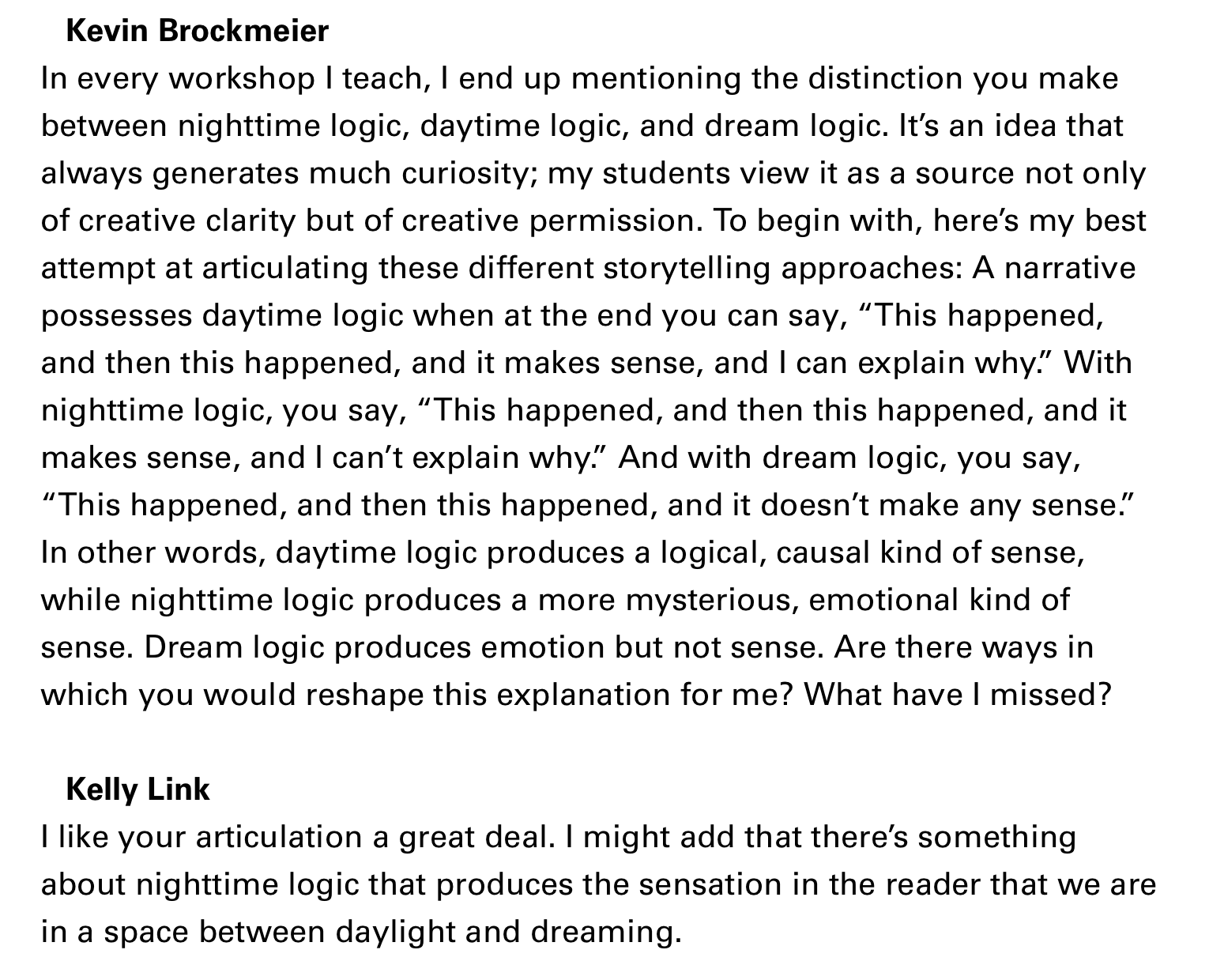
Kevin BrockmeierIn every workshop I teach, I end up mentioning the distinction you makebetween nighttime logic, daytime logic, and dream logic. It's an idea thatalways generates much curiosity; my students view it as a source not onlyof creative clarity but of creative permission. To begin with, here's my bestattempt at articulating these different storytelling approaches: A narrativepossesses daytime logic when at the end you can say, "This happened,and then this happened, and it makes sense, and I can explain why." Withnighttime logic, you say, "This happened, and then this happened, and itmakes sense, and I can't explain why." And with dream logic, you say,"This happened, and then this happened, and it doesn't make any sense."In other words, daytime logic produces a logical, causal kind of sense,while nighttime logic produces a more mysterious, emotional kind ofsense. Dream logic produces emotion but not sense. Are there ways inwhich you would reshape this explanation for me? What have I missed?Kelly LinkI like your articulation a great deal. I might add that there's somethingabout nighttime logic that produces the sensation in the reader that we arein a space between daylight and dreaming.
Figure 1. Kevin BrockmeierIn every workshop I teach, I end up mentioning the distinction you makebetween nighttime logic, daytime logic, and dream logic. It's an idea thatalways generates much curiosity; my students view it as a source not onlyof creative clarity but of creative permission. To begin with, here's my bestattempt at articulating these different storytelling approaches: A narrativepossesses daytime logic when at the end you can say, "This happened,and then this happened, and it makes sense, and I can explain why." Withnighttime logic, you say, "This happened, and then this happened, and itmakes sense, and I can't explain why." And with dream logic, you say,"This happened, and then this happened, and it doesn't make any sense."In other words, daytime logic produces a logical, causal kind of sense,while nighttime logic produces a more mysterious, emotional kind ofsense. Dream logic produces emotion but not sense. Are there ways inwhich you would reshape this explanation for me? What have I missed?Kelly LinkI like your articulation a great deal. I might add that there's somethingabout nighttime logic that produces the sensation in the reader that we arein a space between daylight and dreaming..

Link uses the term manichaeism in this interview and I don’t know it but didn’t look it up because I wanted to keep reading. then this morning I’m reading https://inthesetimes.com/article/former-left-right-fascism-capitalism-horseshoe-theory and it’s got manichaeism used too.

Losing the Plot: The “Leftists” Who Turn RightWhat do we make of former friends who fell down the rabbit hole of the Right?In These Times

Dang. so I go pop open https://en.wikipedia.org/wiki/Manichaeism and from there eventually land on https://en.wikipedia.org/wiki/Bogomilism, which, haha, explains the last Link novel’s name for one of the characters, “Bogomil.”, which I let slide when I read that.

Manichaeism - Wikipediaen.wikipedia.orgBogomilism - Wikipediaen.wikipedia.org

I’m a very, very credulous reader. "Oh, ok, whatever.”

anyway, so bogomil, probably had the usual baggage, but I bet this specific bit didn’t work out too well for them

![wikipedia screenshot, text:Doctrine [edit ]оучать же свою си не повиновати са властелемь своимь; хоулаще богатым, царьненавидать, рягажть са старбишинамь, оукарніть болары, мрьзькы богоу мьнатьработа жщаю цьсарю, и вьсакомоу рабоу не велать работати господиноу свомоу.ucetu je soja si ne povinovati se vlastelem svoim; xuleste bogatyie, cari nenavidet, regajot sẹ stareisinamum, ukarjajot boljary, mriziky bogu minetu rabotajosteje cesarju, i visjakomu rabu ne veleti rabotati gospodinu svojemu.They teach their followers not to obey their masters; they scorn the rich, they hate the Tsars, they ridicule their superiors, they reproach the boyars, they believe that God looks in horror on those who labour for the Tsar, and advise every serf not to work for his master. 32]- Cosmas the Priest, Treatise Against the Bogomils](./113448223430456892.png)
Proximate posts in the Mastodon collection
newer Mastodon post from November 7, 2024, 113443102522541512 07 November 2024
this post Mastodon post from November 7, 2024, 113439890422927632 07 November 2024
older Mastodon post from November 7, 2024, 113439621912571569 07 November 2024
Proximate posts in the General collection
newer Mastodon post from November 7, 2024, 113443102522541512 07 November 2024
this post Mastodon post from November 7, 2024, 113439890422927632 07 November 2024
older Mastodon post from November 7, 2024, 113439621912571569 07 November 2024