1. Rocking @will_torres’s face off with The Oxes in preparation for @charmsec to combat his new Lionell Ritchie “Hello” replacement ‘ygm’ sound

  2. Also: If you don’t hate e-mail like we do, sign up for the CharmSec list so’s we can sell your info for beer money: http://is.gd/vqG9

  3. @oneeyedcarmen yes sir! 7PM @ Slainte. I’ll go ahead and RT it from @charmsec

  4. WikipediA on the front page is now WIKIPEDIA. Why? BookendS > SOLID imo.

  5. @satie45 & @electricfork captured some pics of why your Baltimore commute sucked today: http://twitpic.com/45lb6 http://twitpic.com/45k73

  6. @s_crawford, @chriseng, @dionthegod, @IBMFedCyber, @Fred0828, @ryanaraine, & @geekgrrl thanks for the ★! Aw, shucks, etc. =)

  7. How I Decoded the Verizon 2009 DBIR Cover

    I was the first to solve the Verizon 2009 Data Breach Investigations Report cover. Chris Eng’s similar write-up is excellent and perhaps more in the spirit of defeating a challenge of the sort.

    That wasn’t how I solved it though.

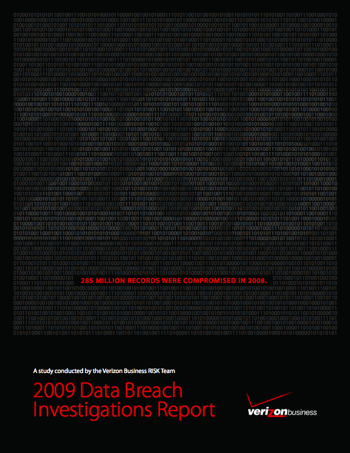
    2009 Verizon DBIR cover
    Figure 1. 2009 Verizon DBIR cover.

    Below lie spoilers. You’ve been warned.

    I have no idea what I’m doing when approaching a cryptographic challenge. My
    background is in art.

    I approached the challenge naively unaware it even was a challenge. A
    designer had been asked to put 1s and 0s on the cover of the report
    because hey, it’s about computer stuff right? That’s what I thought at least.
    I’ve been asked to do that sort of thing, and copy and pasting finger-mashed
    1s and 0s is boring. I always made an effort to make my gibberish mean
    something
    . At the least, I’d find Cicero’s lorem ipsum dolor sit amet et cetera ad nauseum.

    I assumed something amusing would be there but didn’t bother much with it. It
    was 5:30AM and the report made better coffee reading than the cover. When I
    reached the end though, I found the major clue.

    So I tweeted about it.

    Verizon Breach Report, page 48: Notice it? It’s 2 searches away from
    WikipediA. Common cipher lore? Neat regardless! https://www.verizon.com/business/products/security/

    Cybersecurity Solutions: Network Security & Data ProtectionProtect your data with Verizon's advanced cybersecurity solutions. Explore managed security services, SASE, DDoS protection, and mobile device management to secure your network and endpoints.Verizon Business (opens in a new tab)

    By two searches away from WikipediA, I meant, as others have noted that it was a one-hit google search at the time, for a geocaching clue.

    Handy. Even handier is the ‘decrypt’ link on the geocaching site, yielding the
    original text, le chiffre indéchiffrable. Seems like an obvious clue! As I
    related in my tweet, that led me straight to the WikipediA article on the
    Vigenère cipher.

    So then I read up on Vigenère. I’m kind of into just hopping through WikipediA. I read up on Caesar ciphers, of which rot-13 is one. I joked about it on twitter and went back to syndicated feeds and twitter, then drove to work.

    What is The Verizon Breach Report cover binary text? http://is.gd/hafb please be Clutch lyrics, please be Clutch lyrics, please be Clutch l-

    At the office, I asked a few co-workers if they had noticed the clue on page
    48, and showed them that the cover text was probably something. I had no
    idea what, but hey presto, let’s give it a spin.

    I threw the source 1s and 0s into Vim and got rid of all the newlines.
    Nothing useful. Then I tossed the single long line into TextMate to play with
    wrap points.

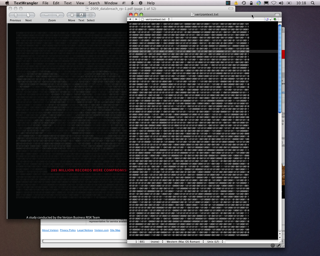
    While shifting it around in Textmate I noticed a pattern.

    A pattern emerges… http://is.gd/sz5k #vzbdir

    screen shot
    Figure 2. screen shot.

    Neat columns, but what does it mean? I didn’t know. I was getting tired of
    moving the source text around though, and knew it was copy and pasted a few
    times, because I was still going on the naive ‘it is nothing or it is funny’
    approach. I selected the first line and searched-all in TextMate. Four hits on
    lines 101, 201, etc… I did the same for the second and third lines. Sure
    enough, only the first 100 lines were unique. Oh well that proves nothing,
    back to work.

    Only the first 100 lines matter. Off to blue team, will have to resume
    after lunch. Argh, obviously a Vigenère. http://is.gd/sz5k #vzbdir

    After my morning meetings, I decided to keep at it through lunch. After
    talking to my friend Ben, we agreed I should just
    script out ascii one letter at a time whether that was what I was looking at
    or not. All the easy to find online ascii-binary converters wouldn’t accept
    it. I read up on perl’s pack() and threw this together.

    #!/usr/bin/perl -w
    # bin-to-ascii
    my $binary_text = shift;
    open (BINARY, $binary_text) or
        die "Can't open input file: $!";
    foreach my $line () {
        my $length = length($line);
        my $hex = pack("B$length", $line);
        print "$hex ";
    }

    Simple enough, what does that yield?

    evntxigyimwsneheiefotxbscwyhrqmwguzabvycbbfreyfbvedkevmfri
    fngfnrbfgvksfpnbufzjgceeewakhpxebtzjczowgtbsqgtmiaydpydriryetkcjrpyhepwkuoa
    eknvtvzhsmznttivikmmrysnuiakbrkqmstycgccrlrriirefgytjubuxheysgleyrvhiyxdeyzcj
    kvtosoixjehoxevmwjbnzmtkwzefofcnbwncuwmyfiuvbkwnpwtyoeyqtirryrcmnvfvlrsbn
    tpwpaoczpekhlfceerrvwvuybvjpuvpoaymikqqnswzghzkdgylaegwpkesgcyzfvjdmepq
    ksslnvsvpuvvrvyerhdtutyymqgevwrmqszfnpnrjiggwajnnjlkoeqhnetrpuqydfzwczkvje xlm
    ckcsiftctsutldrrmikqtninpgrpqqxptzdpaiotceuazfewdqllpzrhxlxqgslrjtblzrirvisnzi
    wl mvyadvohfevnakkgorrxsygxpumvgbomrjlcrefcmrqvxtmiymjjvhxnbtszmtjefkfgkurfl
    nhxpkcwlexmiylgynnrwaksewthpkgzkkxgazellutayciekwishundkekwargbyzfgkepkqg
    zzsrimflgkarturainsngeeumexrveelzxtisuwvzkoyltpbhzweoqwnxnpxpkssxjhpancvfpr
    yadrlroewebqewhzrgatzdguceklfyhzjnnzijrgnzrvbocauyezgkpsjxjiasmvftdwfxbidhqz
    eykdrtdrioppkjrpisskmczjfztbvbjugeyanjigjtdcptzdeogutlzpekhtnihtggumvgbomrjlcr
    efswfzocroheau
    

    Whoa! Letters! Chris Eng got this far immediately with a shell one-liner: sick fu!.

    I had no idea how to attack the Vigenère but given the clue on page 48, that’s
    where I had to start. I read up on brute forcing Vigenère. Yikes. If it’s possible, I can probably find a tool to do it. I found lots, but the first hit was enough.

    I asked Munsee and Leech’s java applet to find 5 keys. The first one
    looked like a winner.

    crangingdefaultcrrdsntialschangingdlfeultfredentials

    A few typo’s but that’s obviously English. I fixed the typos and used the key
    and Munsee and Leech’s java applet again to decrypt the text.

    changingdefaultcredentialschangingdefaultcredentials

    By the time lunch was over, I’d discovered the source text, found out it was actually a contest, and submitted my answer.

    @alexhutton I just submitted my cipher
    text solution. Never done any code breaking before, was a lot of fun!
    #vzdbir (now back to work!)

    I got a call an hour later.

    I was the first to submit! I’d won!

    Congratulate me at CharmSec this Wednesday, and I’ll
    buy you a beer.

    Update

    I just used this old ascii <-> hex <->binary converter
    I keep handy and noticed it would have converted the binary for me. I use it
    for hex so much I forgot it handled binary. I didn’t need that perl script
    after all. Doh.
  8. Why does my macbook pro feel like a candidate for an anarchist’s cookbook recipe? Oh, just some crashed shells. http://is.gd/uX6X

  9. @alexhutton awesome, @charmsec is a fun group of talent with an infosec problem.

Pizza Slow (high quality)

© 2026 gravely